 previous page
 |

|
view print

|
|
previous page |
|
view print
|
| Utagawa YOSHITORA (fl. 1850 - 1880) |
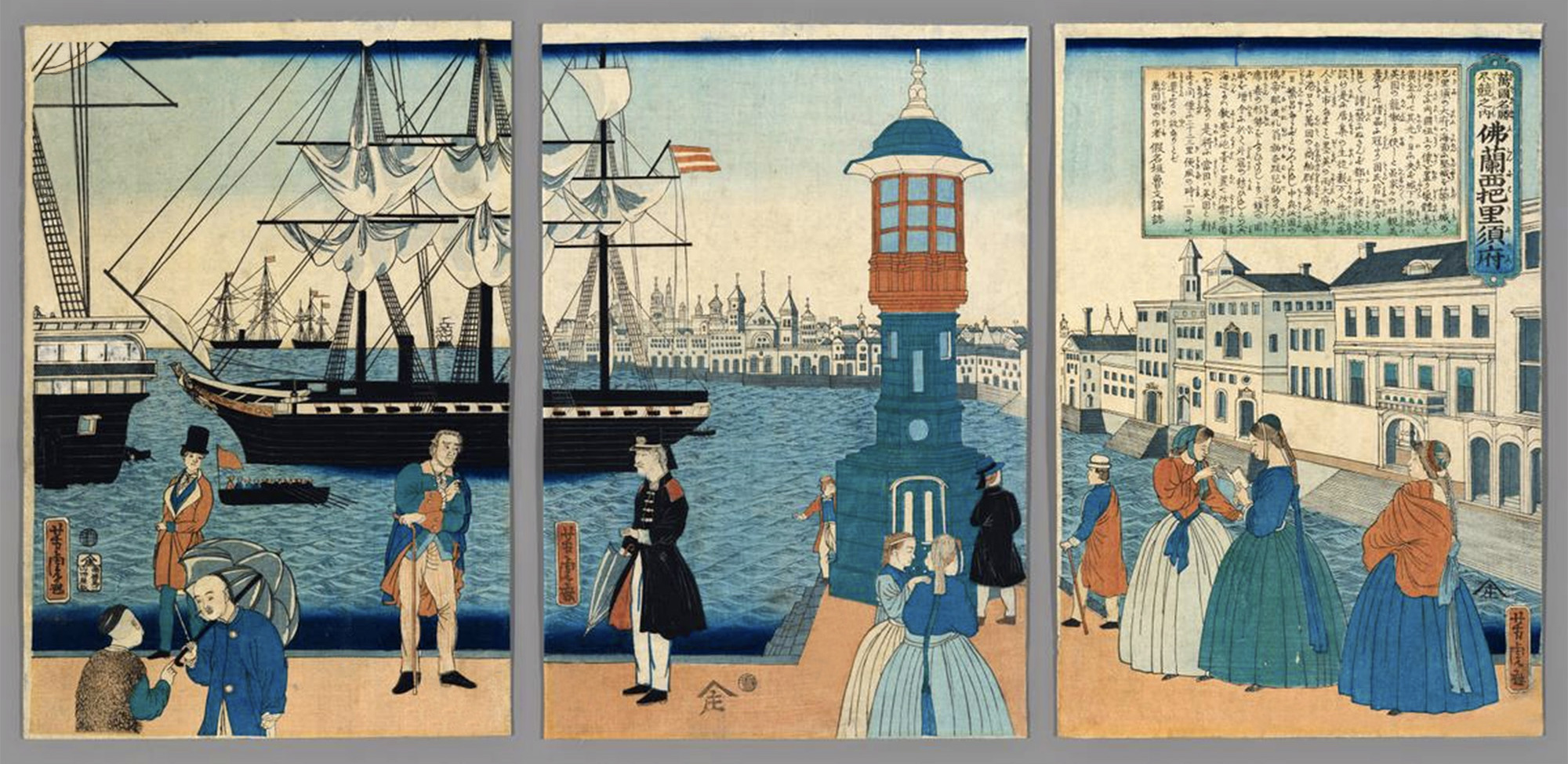
The City of Paris, France (!!) from the series: Some Famous Places of All Countries |
||
|
Signed: Yoshitora ga Date: 6th month, 1862 Publisher: Yamada-ya Shôjirô Size: ôban triptych (c. 37 x 25.5 cms / c. 14 1/2" x 10", each sheet) Condition: Very good impression, color and condition. Full size with margins. ref. no.: # 773393 Price: € 3,500.00 |
|
Triptych from the series, "Some Famous Places of all Countries". When Japan had opened the country to foreigners in the 1850s and had come in contact with Western culture, technology, fashion and life-style, it did not take long until such themes entered the world of Ukiyo-e, the Japanese woodblock print in particlar. This not only included views of foreigners in Japan, but also the depiction of such far away places like Paris, London or Stockholm in Europe, or New York in the United States of America, - places that none of the artists had ever visited. The result was that such depctions had nothing to do with the geographic reality, but were mere products of their imagination, - as is the case with the present "View of Paris". - Such prints were mainly produced in the city of Yokohama where foreigners were allowed to settle in the early years after Japan's opening to the West. They, therefore, were called Yokohama-e. Reference, a.o.: Gerhard Dambmann, Wie Japan den Westen entdeckte - Eine Geschichte in Farbholzschnitten ('How Japan discovered the West - A History in Color Woodblock Prints'), Stuttgart and Zurich, 1988; b/w ill. no. 32, pp. 74-75. - The illustration in that book carries the following description: "The City of Paris in France. - The inscription by Kanagaki Robun describes Paris as a fortified city on the seashore, where a statue of pure gold represents the founder of Paris. He continues that this city was smaller than London and that houses looked very nice and the people were intelligent and gifted. He says that things were very busy in the port. Since Emperor Napoleon's reign, there has been no competition to fear. Nevertheless there were cannons on the beach, because England was very close." |
previous page
view print